
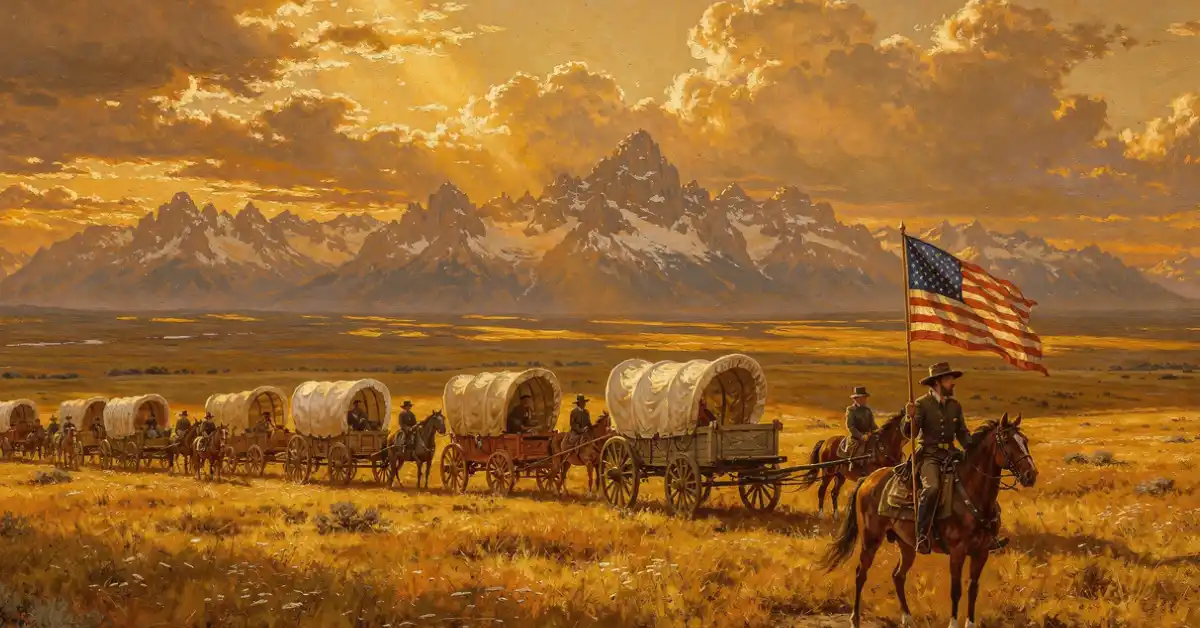
What is manifest destiny? Simply put, it was the belief, held passionately by millions of 19th-century Americans, that the United States was divinely chosen to expand across the entire North American continent. Journalist John L. O’Sullivan coined the term in 1845, but the thinking behind it had been building for decades. It blended religious conviction, nationalist pride, and raw economic hunger into one powerful ideology. Consequently, it drove one of the most consequential territorial expansions in modern history.
This idea did not arrive quietly. It swept through American politics, culture, and military action like a wildfire, reshaping lives across the continent, for better and, in many cases, dramatically for worse.
Whether you are a student, a history enthusiast, or simply curious about how today’s United States came to look the way it does on a map, this guide breaks everything down clearly and completely.
What Is Manifest Destiny? A Simple, Clear Definition
Manifest destiny in one sentence: Americans in the 1800s believed their nation had an obvious (“manifest”) and God-given right (“destiny”) to control the entire North American continent.
The word “manifest” means obvious or clear. “Destiny” means a predetermined fate. Together, they sent a very bold message: westward growth was not a choice, it was an inevitability baked into the nation’s purpose.
For a what is manifest destiny easy definition for kids: Imagine your neighbor saying, “This whole street belongs to us because we are meant to have it.” That, essentially, is what American leaders claimed about the continent. They argued the land was theirs to take and settle, regardless of who already lived there.
Who First Coined the Term “Manifest Destiny”?
O’Sullivan published the term in an 1845 essay in the United States Magazine and Democratic Review. He wrote that it was America’s destiny “to overspread the continent allotted by Providence.” The timing was deliberate, by 1845, the U.S. was already eyeing Texas, Oregon, and California. His words gave a clean name to something politicians had felt for years but had not yet so neatly packaged.
Key Fact: The U.S. grew from roughly 890,000 square miles in 1776 to over 3 million square miles by 1853, an increase of more than 230%.
Must Read: How to Focus on Your Breath Meditation
Manifest Destiny in American History: The Short Answer
To offer a what is manifest destiny in American history short answer: it was the ideological engine of westward expansion from the 1840s through the end of the 19th century. It justified the annexation of Texas (1845), the Oregon Treaty with Britain (1846), the Mexican-American War (1846–1848), and the Gadsden Purchase (1853). Furthermore, it provided cover for the forced relocation of Native American peoples across the continent.
Importantly, it was not a single event or law. Rather, it was an attitude, deeply embedded in American culture, that the West existed for Americans to claim, develop, and “civilize.” Politicians leaned on it for speeches. Newspapers promoted it as national truth. Settlers lived it daily as they packed wagons and moved into unfamiliar territory.
Three Core Beliefs Behind Manifest Destiny
Most historians identify three intertwined ideas at the heart of this ideology:
- Divine mission: Many Americans believed God had specifically chosen the U.S. to spread democracy and Protestant Christianity westward.
- Racial hierarchy: Leaders wrapped the ideology in claims of Anglo-Saxon superiority, a belief they used to justify conquering and displacing Native Americans and Mexicans.
- Democratic expansion: Supporters insisted that spreading American governance was a benefit to the world, bringing freedom to “undeveloped” territories.
Together, these three pillars made the ideology feel not just acceptable to most white Americans of the era, but morally righteous. That moral certainty, in turn, made it far more powerful, and far more destructive.
Manifest Destiny and Westward Expansion: How They Connected
Westward expansion and manifest destiny are tightly linked, yet they are not identical. Westward expansion describes the physical process: people moving west, territories forming, states entering the union. Manifest destiny, however, describes the belief system that motivated and justified all of that movement.
In other words, expansion was the action, and the ideology was the story Americans told themselves to explain why that action was both righteous and inevitable.
Major Land Acquisitions Driven by Manifest Destiny
The following acquisitions illustrate the belief in direct, measurable terms:
- Texas Annexation (1845): After years as an independent republic, Texas joined the U.S., immediately provoking tension with Mexico.
- Oregon Territory (1846): A diplomatic agreement with Britain handed the U.S. control of the Pacific Northwest, including present-day Oregon, Washington, and Idaho.
- Mexican Cession (1848): After the Mexican-American War, the U.S. gained California, Nevada, Utah, Arizona, New Mexico, and parts of Colorado and Wyoming, roughly 525,000 square miles.
- Gadsden Purchase (1853): The U.S. paid Mexico $10 million for a southern Arizona strip, primarily to build a transcontinental railroad route.
Each acquisition sparked controversy. Each had supporters citing divine purpose and opponents calling it open aggression.
Manifest Destiny Causes and Effects: A Clear Breakdown
What Caused Manifest Destiny to Rise?
Understanding what is manifest destiny causes and effects simple starts with the specific pressures of early 19th-century America:
- Population surge: The U.S. population jumped from about 5 million in 1800 to over 23 million by 1850. Eastern cities grew crowded. Fertile western land offered relief.
- Economic hunger: Farmers, merchants, and industrialists all saw opportunity, rich farmland, overland trade routes, and Pacific ports opening Asian commerce.
- Post-1812 nationalism: Repelling Britain a second time gave Americans enormous confidence. A bold new generation felt the country was destined for continental greatness.
- European rivalry: Britain held Canada to the north. Spain, and later Mexico, occupied the southwest. Many Americans feared losing territory to foreign powers if they waited.
- Religious revival: The Second Great Awakening of the early 1800s stoked a sense that America carried a sacred spiritual mission.
What Effects Did Manifest Destiny Leave Behind?
The effects were vast, lasting, and deeply uneven:
- Continental borders secured: The U.S. reached its present continental shape, becoming one of the largest nations on Earth by land area.
- Indigenous displacement: Hundreds of Native nations lost their homelands through force. The Trail of Tears (1838–1839), during which thousands of Cherokee died on a forced march, stands as one of the era’s most devastating examples.
- The Mexican-American War: The ideology gave political cover for a conflict that many Americans, including a young congressman named Abraham Lincoln, openly called an unjust land grab.
- Slavery debate intensified: Every newly acquired territory forced a single, explosive question: slave or free? That tension built steadily toward the Civil War.
- Economic transformation: The transcontinental railroad, completed in 1869, tied the continent together and opened the West to massive commercial development.
Expert Insight: Historian Frederick Jackson Turner’s famous 1893 “Frontier Thesis” argued that the closing frontier fundamentally shaped American democracy and individualism. Scholars still debate his conclusions today, making it one of the most contested ideas in American historiography.
Manifest Destiny Definition and Examples: The Idea in Real Life
A what is manifest destiny definition and examples summary: Americans expressed this belief across politics, art, military campaigns, and daily life. Specifically, it appeared in:
- President James K. Polk’s election campaign, which ran openly on aggressive territorial expansion.
- Newspaper editorials demanding settlers claim western land before European rivals did.
- Emanuel Leutze’s 1861 painting Westward the Course of Empire Takes Its Way, depicting Rockies-crossing settlers as national heroes.
- John Gast’s 1872 work American Progress, arguably the era’s most famous visual: an angelic figure floats west, stringing telegraph wire, while Native Americans and wildlife retreat before her.
- Military campaigns that systematically removed Native nations from their ancestral lands.
Manifest Destiny Explained in Easy Words for Students
For what is manifest destiny for students explained in plain terms: picture the U.S. in 1840. The country ends roughly at the Mississippi River. Beyond it lies a vast territory, filled with Native nations, Mexican communities, and enormous natural wealth.
American politicians and newspapers began declaring: “That land is ours. God placed us here to claim it.” So Americans went, by wagon, by treaty (often broken), and by military force. Within 15 years, the nation stretched coast to coast.
That story sounds bold and adventurous in many textbooks. However, it also meant the violent removal of hundreds of thousands of people already living on that land. Both truths belong in the full picture.
Why Manifest Destiny Still Matters Today
Few ideas have done more to shape the physical, political, and cultural landscape of the United States than this one. Here is why historians keep returning to it:
It Drew the Map of Modern America
Without this expansionist drive, the country would look very different today. California, Texas, Arizona, Oregon, Washington, all exist in their current form because of territory Americans seized during this era. Moreover, the U.S. would not function as a Pacific power without the ports, trade routes, and resources that western expansion delivered.
A Fundamental Contradiction at the Heart of American Identity
The United States declared “all men are created equal.” Yet simultaneously, American leaders justified removing entire Native peoples from their lands and extending slavery into new territories. That contradiction did not fade quietly. Instead, it exploded into the Civil War (1861–1865), the bloodiest conflict in American history.
The Legacy Lives on in Modern Policy Debates
The story of manifest destiny is not merely a historical curiosity. Indigenous communities continue fighting for land rights and treaty recognition rooted in 19th-century losses. Scholars, activists, and lawmakers regularly engage with this history when discussing land sovereignty, reparations, and American identity. In that sense, manifest destiny never fully ended, it simply changed shape.
Did You Know? Not everyone embraced this ideology even in the 1800s. Frederick Douglass, Henry David Thoreau, and many Whig politicians openly opposed the Mexican-American War. Opposition existed all along, it simply lacked the platform that pro-expansion voices commanded.
Pros and Cons: A Balanced Look at Manifest Destiny
Arguments Supporters Made
- Continental security: Controlling the full continent blocked European powers from encircling the young nation.
- Economic growth: New land generated enormous agricultural and commercial wealth across multiple generations.
- Democratic ideals: Supporters genuinely believed U.S. governance offered more freedom than Spanish colonial rule, though historians contest this claim heavily.
- Shared national purpose: Expansion gave Americans a unifying goal during a period of sharp domestic political division.
The Human Costs That Cannot Be Ignored
- Indigenous displacement and death: Millions of Native Americans died, lost their homes, or faced forced assimilation. Entire languages, cultures, and nations collapsed under the pressure.
- An unjust war with Mexico: American expansion provoked a conflict that stripped Mexico of nearly half its national territory.
- Slavery spread westward: New territories opened new battlegrounds over slavery’s expansion, accelerating the march toward civil war.
- Racism embedded in law and culture: The ideology rested on, and reinforced, white supremacist ideas that treated non-white peoples as unfit for self-governance.
Practical Tips for Studying Manifest Destiny
- Begin with primary sources. O’Sullivan’s 1845 essay, Polk’s war messages to Congress, and Native American accounts of removal offer sharply different perspectives on the same events.
- Study the maps closely. Tracking U.S. territorial growth decade by decade reveals just how rapid and intentional the expansion actually was.
- Resist the single narrative. Manifest destiny was not a unanimous belief. Fierce debates erupted in Congress, newspapers, and churches, understanding them enriches the full picture.
- Connect it to current events. Many ongoing Native land sovereignty cases trace directly back to treaties signed, and broken, during this era.
- Compare it across empires. Britain used similar language to justify Indian colonialism. France did the same in North Africa. Examining those parallels shows how common “destiny” narratives were among 19th-century colonial powers.
Conclusion: What Is Manifest Destiny and Why Does It Still Matter?
What is manifest destiny? It is one of the most consequential, and morally complicated, ideas in American history. On one hand, it gave a young nation the ambition to stretch from ocean to ocean in under a century. On the other hand, it authorized the destruction of Indigenous peoples, the seizure of Mexican territory, and the entrenchment of racial hierarchies that shaped society for generations.
Ultimately, understanding this ideology means holding both truths at once: the ambition and the atrocity, the expansion and the erasure. That is uncomfortable history. Nevertheless, it is honest history, and honest history is the only kind worth studying.
The West was not empty. The destiny was not divine. And the consequences, as Indigenous communities and historians remind us daily, remain very much alive.
Frequently Asked Questions
What is manifest destiny in one sentence?
Manifest destiny was the 19th-century American belief that the United States carried a divine and obvious right to expand its territory across the entire North American continent, from the Atlantic to the Pacific Ocean.
What is manifest destiny and why was it important?
It was the ideological engine behind U.S. westward expansion throughout the 1800s. Its importance lies in how it shaped the country’s present geography, triggered the Mexican-American War, accelerated the displacement of Native peoples, deepened the slavery debate, and ultimately established the U.S. as a continental power.
What is manifest destiny easy definition for kids?
It was the belief that American settlers were meant, by God and fate, to control all the land between the East and West Coasts. Americans called this their “obvious” and “unavoidable” purpose, and they acted on it aggressively throughout the 1800s.
What are the main causes and effects of manifest destiny?
Key causes include rapid population growth, economic pressure, post-1812 nationalism, religious revival, and rivalry with European powers. The effects include massive U.S. territorial growth, forced removal of Native Americans, the Mexican-American War, intensified slavery debates, and the eventual conditions that ignited the Civil War.
Who benefited from manifest destiny and who was harmed?
White American settlers and politicians gained land, resources, and political power. In contrast, Native American nations, who lost their homelands through forced removal and warfare, and Mexican citizens, who lost nearly half of Mexico’s territory after 1848, paid the heaviest price.
Sources & Further Reading
- Howe, Daniel Walker. What Hath God Wrought: The Transformation of America, 1815–1848. Oxford University Press, 2007.
- Heidler, David S. & Jeanne T. Manifest Destiny. Greenwood Press, 2003.
- Turner, Frederick Jackson. “The Significance of the Frontier in American History.” 1893.
- O’Sullivan, John L. “Annexation.” United States Magazine and Democratic Review, 1845.
- Calloway, Colin G. One Vast Winter Count: The Native American West before Lewis and Clark. University of Nebraska Press, 2003.