
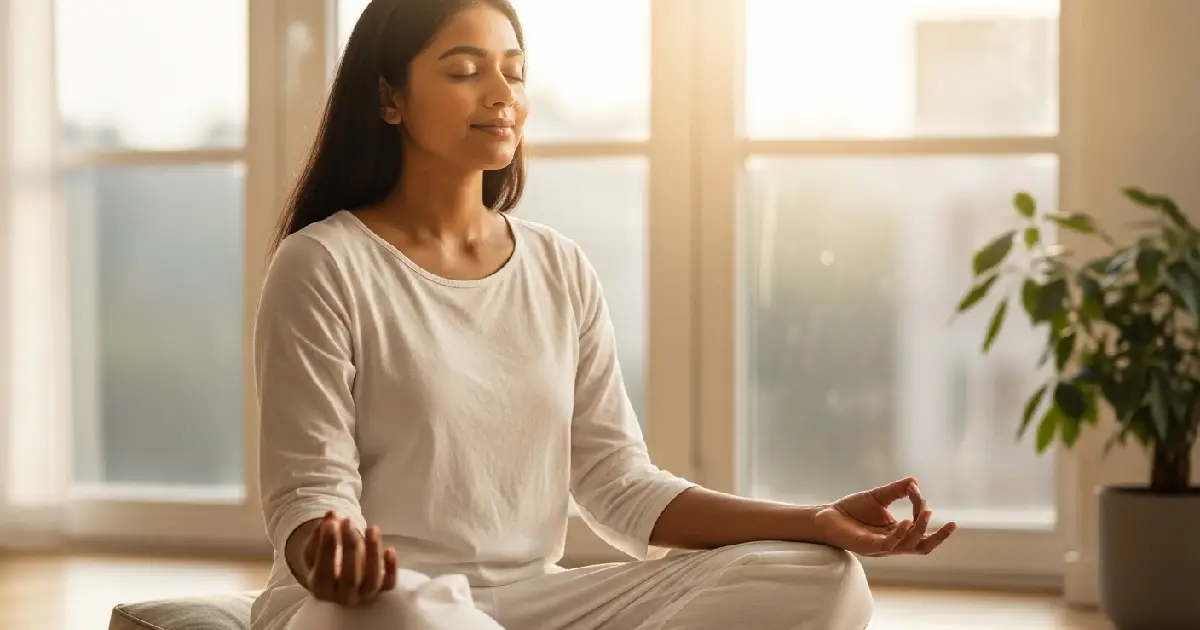
If you have ever tried to sit quietly and just breathe, you already know how difficult it can be. Thoughts race in, the to-do list gets louder, and the breath — the one thing you were supposed to watch — slips away in seconds. Learning how to focus on your breath meditation is one of the most practical skills you can build for mental clarity, emotional regulation, and lasting calm. It costs nothing, requires no equipment, and works anywhere.
This guide is built on evidence-based mindfulness principles and real practice experience. Whether you have never meditated before or you keep falling off the habit, you will find clear, honest, and actionable guidance here.
What Is Breath-Focused Meditation and Why Does It Work?
Breath-focused meditation — sometimes called breath awareness meditation technique — is the practice of intentionally directing attention to the physical sensations of breathing. Unlike visualization or mantra practices, it uses the breath as a live, always-present anchor for the wandering mind.
The science behind it is clear. A 2018 study published in Frontiers in Human Neuroscience found that participants who practiced breath-focused attention for just 8 weeks showed measurable improvements in sustained attention, emotional regulation, and stress reactivity. The breath is the only autonomic function humans can consciously control, making it a uniquely powerful bridge between the body’s automatic systems and the thinking mind.
Here is why it works so well:
- It is always available. You do not need an app, a quiet room, or a special cushion. Your breath is with you at all times.
- It interrupts rumination. Focusing on a physical sensation breaks the loop of repetitive anxious thinking.
- It activates the parasympathetic nervous system. Slow, conscious breathing signals safety to the nervous system, reducing cortisol and lowering heart rate within minutes.
- It trains attention like a muscle. Every time you notice your mind has wandered and bring it back to the breath, you are performing a mental “rep” that strengthens concentration over time.
Benefits of Breath Meditation: What the Research Shows
Before diving into the practice, it helps to understand what you are working toward. Here is a clear breakdown of the validated benefits of consistent breath meditation:
Mental Benefits
- Improved working memory and focus span
- Reduced symptoms of anxiety and depression
- Greater emotional regulation under stress
- Enhanced creative problem-solving
Physical Benefits
- Lower resting heart rate and blood pressure
- Improved sleep quality
- Reduced cortisol (the primary stress hormone)
- Better immune function over time
Practical Daily Benefits
- Faster recovery from stressful events
- Greater patience in difficult conversations
- More deliberate, less reactive decision-making
A 2019 meta-analysis in Psychological Bulletin reviewed 200+ mindfulness studies and concluded that breath-based mindfulness consistently produces moderate-to-large improvements in attention and well-being — even with short daily sessions.
How to Focus on Your Breath Meditation: Step-by-Step for Beginners
This is the core of what most people come here for. The following is a practical, no-nonsense method for simple breath meditation step by step that works for absolute beginners and experienced practitioners alike.
Step 1: Choose Your Position
Sit comfortably. You do not need to sit cross-legged on the floor. A chair with your feet flat on the ground works perfectly. The key requirements are:
- Spine upright but not stiff
- Hands resting gently in your lap
- Eyes closed or soft gaze directed slightly downward
Lying down is possible but increases the chance of falling asleep, especially for beginners.
Step 2: Set a Time Limit
Start with 5 to 10 minutes. Use a gentle timer so you are not checking a clock. Research consistently shows that short, consistent sessions build the habit more reliably than occasional long ones. Work toward 20 minutes once the habit is established.
Step 3: Take Three Deliberate Breaths
Before you begin the formal practice, take three slow, full breaths intentionally. Inhale through the nose for 4 counts, hold gently for 2, and exhale through the nose or mouth for 6 counts. This signals the nervous system that a shift is happening and gives you an initial anchor.
Step 4: Let the Breath Return to Its Natural Rhythm
This is where beginners often make the critical mistake of trying to control the breath throughout the entire session. After your three deliberate breaths, let go of control. Allow the breath to find its own natural rhythm. Your only job now is to observe it.
Notice:
- Where do you feel the breath most clearly? (Nostrils, chest, belly?)
- Is it shallow or deep?
- Is the inhale shorter or longer than the exhale?
- Is there a natural pause between breaths?
Choose one spot to anchor your attention — most practitioners find the nostrils or the belly the easiest starting point.
Step 5: Stay with the Sensations
This is the actual practice of how to concentrate on breathing meditation: staying with the raw physical sensations of the breath. Not thinking about the breath. Not narrating it. Just feeling it.
Some practitioners find it useful to silently label: “in” on the inhale and “out” on the exhale. This labeling technique helps the mind stay anchored without getting lost in commentary.
Step 6: Notice When the Mind Wanders (It Will)
Your mind will wander. This is not failure. This is the practice. The moment you realize your attention has drifted to a thought, a sound, or a feeling, you have successfully completed a moment of mindfulness. Gently — without frustration or judgment — return your attention to the breath.
Each return is one repetition of the attention muscle. This is precisely how to improve focus through breathing meditation.
Step 7: Close with Intention
When your timer sounds, do not jump up immediately. Take 30 seconds to notice the quality of your mind. Then slowly open your eyes and allow yourself to re-enter the room before standing.
Common Mistakes and How to Avoid Them
Even experienced meditators make these errors. Knowing them in advance saves weeks of unnecessary frustration.
- Mistake 1: Trying to stop thinking Meditation is not about emptying the mind. It is about noticing thought and returning to the breath. Fighting thoughts creates tension that defeats the purpose.
- Mistake 2: Controlling the breath too much If you spend the session manipulating your breathing, you are doing a breathing exercise — not breath meditation. Both have value, but they are different practices.
- Mistake 3: Judging the quality of the session A session filled with distraction is not a bad session. Every return to the breath is practice. Some of the most valuable sessions feel like the worst ones because your awareness is sharp enough to notice everything.
- Mistake 4: Skipping sessions when busy The days when you feel you do not have time to meditate are almost always the days when you need it most. Even two minutes of intentional breath awareness works.
Mindful Breathing Exercises for Beginners: Three Variations to Try
If simple breath observation feels too abstract at first, these structured mindful breathing exercises for beginners provide more scaffolding to work with.
1. Box Breathing (4-4-4-4)
Inhale for 4 counts → Hold for 4 → Exhale for 4 → Hold for 4. Repeat for 5 minutes. This is used by military special forces and high-performance athletes to achieve rapid nervous system regulation.
2. 4-7-8 Breathing
Inhale for 4 counts → Hold for 7 → Exhale for 8. The extended exhale activates the vagal nerve, producing a measurable calming effect within seconds. This is particularly useful before sleep.
3. Counted Breath Meditation
Breathe naturally. Count each exhale from 1 to 10, then start again. If you lose count, simply return to 1 without judgment. This gives the analytical mind a task while training sustained attention — one of the most accessible deep breathing meditation techniques for restless minds.
Building a Sustainable Practice: Tips That Actually Work
Knowing the technique is only the beginning. The real transformation comes from making this a reliable daily habit. Here is what decades of mindfulness research and practitioner reports consistently show:
- Anchor it to an existing habit. Practice immediately after your morning coffee, before your first work task, or right after brushing your teeth at night. Habit stacking dramatically increases follow-through.
- Start smaller than you think you need to. Committing to 3 minutes daily for 30 days produces more lasting results than committing to 30 minutes and abandoning it after a week.
- Use environment design. A specific chair, a cushion, even a scented candle used only during practice — these environmental cues train the brain to shift into a meditative state more quickly over time.
- Track streaks but do not worship them. A missed day is not a reason to quit. The research on habit formation shows that missing one day has no measurable impact on long-term habit strength — missing two or three days in a row does.
- Use guided audio for the first month. A guided breathing meditation for focus removes decision fatigue and gives you something to follow while you are still building internal awareness. After a month, you will likely find you prefer silence.
Expert Perspective: What Experienced Meditators Know That Beginners Don’t
Jon Kabat-Zinn, the founder of Mindfulness-Based Stress Reduction (MBSR) and arguably the most influential figure in bringing meditation into Western clinical settings, describes the breath as “the original teacher.” In his view, the breath does not need to be interesting for the practice to work — the noticing itself is the practice.
There is a quality that experienced meditators describe that beginners rarely have language for: the shift from doing breath awareness to being with the breath. Early in practice, concentration feels like holding something. Later, it begins to feel like resting. The technique does not change. The relationship to the technique does.
This shift — from striving to allowing — is the most consistently reported marker of developing a genuine breathing mindfulness practice guide that becomes self-sustaining. You stop meditating because you scheduled it. You start meditating because it has become where you go to feel like yourself again.
How to Calm Your Mind with Breathing Meditation During Difficult Moments
Most people learn to meditate in calm conditions and then wonder why the technique fails them under real stress. The answer is simple: you have not practiced using it under stress.
Here is a practical protocol for how to calm mind with breathing meditation in difficult moments:
- Name the state. Before trying to change anything, silently identify what you are experiencing: “There is anxiety here.” Naming activates the prefrontal cortex and reduces amygdala reactivity.
- Find the breath. Place one hand on your belly. Feel three natural breaths without changing them.
- Extend the exhale. Make the exhale 2 counts longer than the inhale. Do this for 5 cycles.
- Return to the situation. You have not solved anything — but you have accessed the part of your brain that can.
Practice this in low-stakes situations first: minor irritations, mild boredom, restlessness in a line. You are training a reflex that will be available when you truly need it.
Pros and Cons: An Honest Assessment
Pros:
- Costs nothing and requires no equipment
- Backed by extensive peer-reviewed research
- Accessible to almost anyone regardless of age or physical ability
- Benefits appear within days to weeks of consistent practice
- Translates directly to improved daily functioning
Cons:
- Initial sessions often feel frustrating or boring
- Requires consistency — sporadic practice produces minimal results
- Not a substitute for professional mental health treatment in clinical cases
- Some individuals (particularly those with trauma histories) may find breath focus uncomfortable — in these cases, open awareness or body-scan practices may be more appropriate starting points
Focus on Breath Meditation Tips: Quick-Reference Summary
- Always anchor to one specific sensation (nostrils OR belly, not both)
- Do not control the breath — observe it
- When distracted, return without self-criticism
- Consistency matters more than duration
- Short daily sessions outperform occasional long ones
- Use structure (box breathing, counted breaths) when pure observation feels too slippery
- Practice in stress so the skill is available when you need it
Conclusion
Knowing how to focus on your breath meditation is not complicated. But simple is not the same as easy. The breath is always there, waiting — the practice is learning to return to it again and again without frustration, without self-judgment, and without needing the session to look a particular way.
Start with five minutes tomorrow morning. Follow the steps in this guide. Expect distraction. Return to the breath. That is the entire practice. Everything else — the calm, the clarity, the focus — is what accumulates when you keep showing up for that simple act of return.
The breath has been described across contemplative traditions for thousands of years as the doorway between the body and the mind. Science has since confirmed what practitioners already knew: it works. Use it.
FAQ
How long should I focus on my breath during meditation as a beginner?
Start with 5 to 10 minutes daily. Research shows that consistent short sessions are more effective for building the meditation habit than infrequent longer ones. Once 10 minutes feels comfortable, gradually increase to 15 or 20 minutes.
What should I do when my mind keeps wandering during breath meditation?
Nothing unusual — this is the practice. Every time you notice your mind has wandered and return attention to the breath, you have completed one rep of mental training. Do not try to stop thinking; simply redirect attention to the breath without self-criticism.
Should I breathe through my nose or mouth during breath meditation?
For most breath meditation practices, breathing through the nose is preferred. Nasal breathing activates the diaphragm more fully, warms and filters the air, and produces a slightly more consistent rhythm that is easier to observe. However, during techniques that emphasize longer exhales (like 4-7-8 breathing), exhaling through the mouth is appropriate.
Can breath-focused meditation help with anxiety?
Yes. Multiple peer-reviewed studies support breath meditation as an effective complementary tool for managing anxiety symptoms. The extended exhale in particular activates the parasympathetic nervous system, which counteracts the physiological stress response. However, those with clinical anxiety disorders should use breath meditation alongside — not instead of — professional treatment.
How many times a day should I practice breath awareness meditation?
Once daily is sufficient for most people and is what the research most consistently validates. Some practitioners find value in a brief secondary session (2 to 3 minutes) in the afternoon or before a particularly challenging task. Quality and consistency matter more than frequency.
Disclaimer: The information provided in this article is intended for general educational and informational purposes only and does not constitute medical, psychological, or therapeutic advice. While breath-focused meditation has been supported by numerous peer-reviewed studies as a complementary wellness practice, it is not a substitute for professional mental health treatment, clinical therapy, or medical care. Individuals living with anxiety disorders, trauma, PTSD, respiratory conditions, or any other diagnosed physical or mental health condition should consult a qualified healthcare provider before beginning any new meditation or breathing practice. Results from meditation vary between individuals, and the techniques described here may not be appropriate for everyone. The author and publisher assume no liability for any outcomes, direct or indirect, arising from the application of the content in this article.