
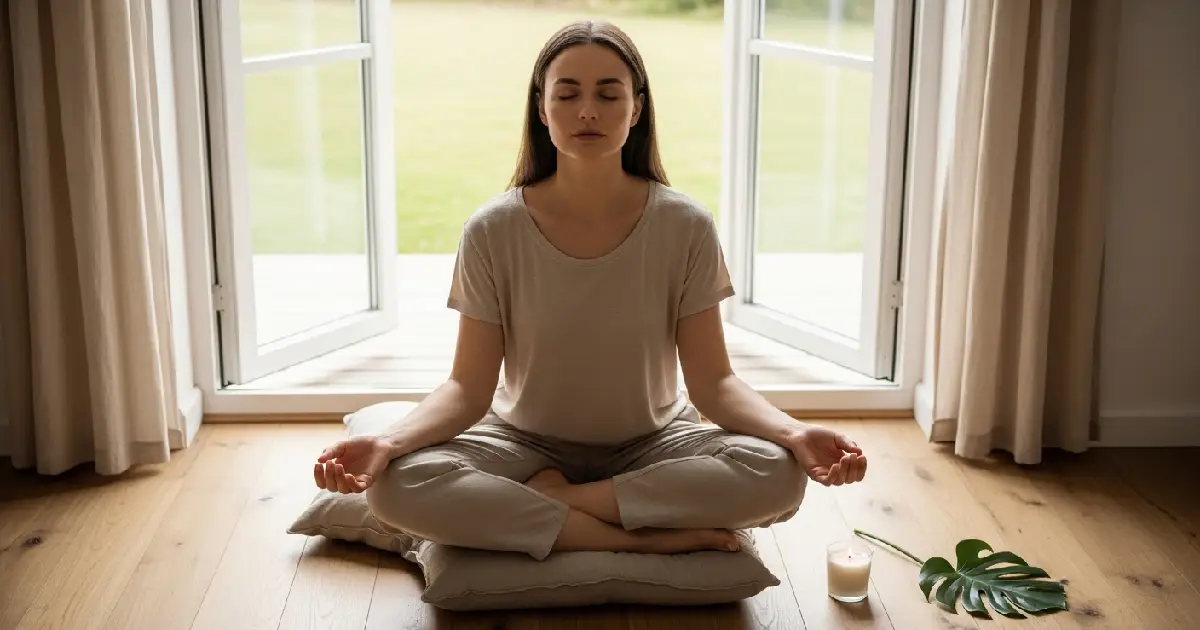
A five minute breathing meditation is one of the most powerful — and most underestimated — tools you have for managing daily stress. Five minutes. No app required. No gym membership, No special equipment, Just your breath and a quiet moment of intentional attention. Yet research consistently shows that this brief practice can lower cortisol levels, reduce anxiety, and improve your ability to concentrate throughout the day.
Most people spend years looking for complex solutions to stress, sleep problems, and mental fog — when the answer has literally been right under their nose the whole time.
This guide will show you exactly how a five-minute breathing meditation works, why it works, and how to build it into your daily life starting today.
What Is a Five Minute Breathing Meditation?
At its core, a five-minute breathing meditation is the practice of placing your full, deliberate attention on the physical act of breathing — for five uninterrupted minutes. You observe the natural rise and fall of each breath without trying to control or change it. When your mind wanders (and it will), you simply notice it has drifted and calmly return your focus to the breath.
This is not a complicated practice. It does not require you to empty your mind, a common misconception that keeps millions of people from ever trying meditation. It does not require silence, incense, or a yoga mat, It simply requires that you show up and pay attention.
This practice is often called mindful breathing, and it forms the foundation of mindfulness meditation. Mindfulness itself is the mental skill of being present with what is happening right now — not replaying the past or rehearsing the future. The breath, because it is always happening in the present moment, makes a perfect anchor.
The Science Behind Mindful Breathing
Before we get to technique, it helps to understand why this works. The evidence is not anecdotal — it is grounded in decades of clinical research.
Your nervous system responds directly to how you breathe. Rapid, shallow breathing activates the sympathetic nervous system — the “fight or flight” response. Slow, deliberate breathing activates the parasympathetic nervous system — the “rest and digest” state. By consciously slowing your breath even for a few minutes, you are sending a direct physiological signal to your brain: the threat is over, you can relax.
Here is what the research shows:
- A 2017 study published in Frontiers in Psychology found that diaphragmatic breathing significantly reduced cortisol (the primary stress hormone) and improved sustained attention performance.
- Research from Stanford University identified that slow, controlled breathing stimulates the vagus nerve, which directly regulates heart rate and stress response.
- A meta-analysis in JAMA Internal Medicine reviewed 47 mindfulness trials and found moderate evidence that mindfulness meditation — which centrally involves breath awareness — reduces anxiety, depression, and pain.
- The Greater Good Science Center at UC Berkeley, which helped develop the mindful breathing protocol behind this article, notes that a regular practice makes it progressively easier to access calm in difficult moments.
In short, you are not just “relaxing” when you do this practice. You are actively retraining your nervous system.
Benefits of a Daily Five-Minute Breathing Meditation
Consistency matters more than duration here. Even five minutes done daily produces measurable changes over time. Here is what regular practitioners report — and what the science supports:
Mental & Emotional Benefits:
- Reduced anxiety and rumination
- Lower emotional reactivity in stressful situations
- Greater sense of mental clarity and calm
- Improved mood stability throughout the day
- Stronger ability to focus and sustain attention
Physical Benefits:
- Lower resting heart rate
- Reduced blood pressure
- Decreased muscle tension
- Improved sleep quality (especially when practiced before bed)
- Reduced inflammatory markers associated with chronic stress
Cognitive Benefits:
- Sharper working memory
- Better decision-making under pressure
- Increased creativity and problem-solving capacity
- Greater ability to pause before reacting
Pros and Cons at a Glance
| Pros | Cons |
|---|---|
| Requires zero equipment | Takes practice to build consistency |
| Can be done anywhere | Results take time to compound |
| Backed by strong scientific evidence | Mind-wandering can feel frustrating at first |
| Fits into any schedule | Not a substitute for professional mental health care |
| Free and immediately accessible | Requires deliberate daily commitment |
How to Do a Five-Minute Breathing Meditation: Step-by-Step
This is the core practice. Follow each step carefully, especially if you are new to mindful breathing.
Step 1: Choose Your Position
Sit comfortably — on a chair, on the floor, or on a cushion. Keep your spine upright but not rigid. Rest your hands on your thighs or in your lap. Your eyes can be open or closed, though most people find it easier to maintain focus with eyes gently closed.
You can also do this lying down, though there is a risk of falling asleep if you are tired. Standing is an option as well. The position is less important than the consistency of the practice.
Step 2: Set a Timer
Remove the distraction of clock-watching by setting a five-minute timer before you begin. Use a gentle alarm sound — a soft bell or chime works better than a jarring ringtone that pulls you back harshly.
Step 3: Take One Intentional Breath to Begin
Before settling into natural breathing, take one deliberate grounding breath:
- Inhale slowly through your nose for 3 counts
- Hold gently for 2 counts
- Exhale fully through your mouth for 4 counts
This single breath activates the parasympathetic response and signals your body that the practice has begun.
Step 4: Return to Natural Breathing
After your opening breath, stop controlling the breath. Let it find its own rhythm. Your only job now is to observe it — the sensation of air entering through your nostrils, the slight rise of your chest or belly, the gentle release as you exhale.
Notice where you feel the breath most clearly:
- The tip of your nostrils as air passes through
- The expansion of your chest
- The rising and falling of your abdomen
- The brief pause at the top and bottom of each breath
Pick one anchor point and stay with it.
Step 5: Manage a Wandering Mind — Without Judgment
Within seconds, your mind will probably wander. You will start thinking about what you need to do later, something a coworker said, what to make for dinner. This is completely normal. It does not mean you are doing it wrong.
When you notice your mind has wandered, simply acknowledge it with a brief internal note — “thinking” or “wandering” — and gently redirect your attention back to the breath. No frustration. No self-criticism. Just a neutral return.
This cycle of attention → distraction → noticing → returning is not a failure of the practice. It is the practice. Each time you return, you are strengthening the mental muscle of focused attention. Think of it like a bicep curl — the value is in the return, not in never losing focus.
Step 6: Close Intentionally
When your timer sounds, do not leap up immediately. Spend ten seconds noticing your full body — the weight of it in your seat, the temperature of the air, any sense of stillness or ease. Acknowledge yourself for completing the practice, then open your eyes slowly.
The 4-7-8 Breathing Technique: An Expert-Recommended Variation
For moments of acute stress or anxiety — a difficult conversation coming up, a high-stakes presentation, trouble sleeping — a more structured pattern called 4-7-8 breathing can deliver faster, deeper relief than natural breath observation alone.
Developed by integrative medicine pioneer Dr. Andrew Weil and rooted in ancient pranayama (yogic breathwork), the 4-7-8 technique works by extending the exhale dramatically, which activates the vagal brake on the heart and rapidly induces calm.
How to practice 4-7-8:
- Exhale completely through your mouth, making a whooshing sound
- Close your mouth and inhale quietly through your nose for 4 counts
- Hold your breath for 7 counts
- Exhale completely through your mouth for 8 counts
- Repeat 3–4 cycles
Dr. Weil recommends this as a “natural tranquilizer for the nervous system,” noting that with regular twice-daily practice, its effects strengthen over weeks and months. It is particularly effective as part of your five-minute breathing meditation when you need faster results.
When and Where to Practice: Making It Stick
The most common reason people abandon a breathing meditation practice is not that it is too hard. It is that they never made a clear decision about when to do it. Vague intentions — “I’ll meditate sometime today” — rarely survive contact with a full schedule.
The most effective times to practice:
- First thing in the morning — Before checking your phone, spend five minutes with your breath. This sets a calm, intentional tone for the entire day.
- Before a stressful event — Use a breathing practice as a preparation ritual before an important meeting, a difficult conversation, or any high-pressure moment.
- At the midday slump — Replace afternoon caffeine with five minutes of mindful breathing. It restores mental clarity without the crash.
- Before bed — Wind down the nervous system and improve sleep onset by replacing screen time with a breathing session.
Habit stacking works exceptionally well here. Attach your five-minute breathing meditation to an existing daily habit: right after brushing your teeth, right before your morning coffee, immediately after sitting down at your desk. The existing habit triggers the new one automatically.
Common Mistakes Beginners Make (and How to Avoid Them)
Even with clear instructions, certain errors are almost universal among beginners. Knowing them in advance puts you ahead.
- Trying to stop thoughts The goal is not a blank mind. The goal is noticing your thoughts and returning to the breath. Expecting silence sets you up for frustration.
- Breathing unnaturally Once your opening breath is done, stop engineering the breath. Let it be normal. Some beginners hyper-focus on breathing “correctly” and end up feeling short of breath. Observe; don’t control.
- Practicing only when stressed The five-minute breathing meditation is most effective as a daily preventive practice, not just a crisis intervention tool. Regular sessions build a baseline of calm that makes stressful moments more manageable.
- Giving up after a “bad” session Some sessions feel scattered and distracted. This is normal and does not undo the benefits. Consistency over perfection is the only metric that matters.
- Practicing for too long too soon Starting with 20-minute sessions before you have built the habit almost always leads to abandonment. Five minutes, done daily, creates more lasting benefit than occasional long sessions.
Expert Perspective: What Diana Winston Teaches
Diana Winston, Director of Mindfulness Education at UCLA’s Mindful Awareness Research Center (MARC) and author of The Little Book of Being, is one of the most respected voices in applied mindfulness. Her approach to the five-minute breathing meditation centers on what she calls “natural awareness” — the understanding that stillness is not manufactured but uncovered.
Winston emphasizes that the key shift for beginners is moving from doing to noticing. Instead of trying to force calm, you simply observe whatever is present — tension, distraction, a busy mind — with curiosity and without judgment.
“You might notice that your mind may start to wander,” Winston explains in her guided practice. “It’s very natural. Just notice that your mind has wandered… and then gently redirect your attention right back to the breathing.”
Her instruction to offer yourself “appreciation for doing this practice today” at the end of each session is not a formality. Self-compassion — the willingness to treat yourself with the same kindness you would offer a friend — is itself a core element of sustainable mindfulness practice. Research by Dr. Kristin Neff at the University of Texas at Austin shows that self-compassion is strongly associated with emotional resilience and lower anxiety.
Building From Five Minutes: A 4-Week Progression
Once the five-minute habit is solid, consider this gradual expansion:
| Week | Duration | Focus |
|---|---|---|
| Week 1–2 | 5 minutes | Build consistency; master the basic breath anchor |
| Week 3 | 7–8 minutes | Add a body scan at the close of practice |
| Week 4 | 10 minutes | Introduce loving-kindness phrases at the end |
| Beyond | 10–15 minutes | Explore themed sessions: gratitude, equanimity, open awareness |
There is no need to rush this progression. Many experienced meditators return to five-minute sessions during high-demand periods and find them fully sufficient. The depth of the practice is not measured in minutes.
Conclusion
A five minute breathing meditation is not a compromise. It is a complete, powerful practice — accessible to anyone, executable anywhere, and backed by decades of clinical research. In just five minutes a day, you can measurably reduce stress hormones, sharpen your ability to focus, and build a baseline of calm that carries you through even your most demanding days.
The breath is always with you. The only question is whether you are paying attention to it. Start today — set a five-minute timer, find a comfortable seat, and let the simplest practice you will ever learn begin doing the most important work of your life.
FAQ
How long does it take to see results from a five-minute breathing meditation?
Many people notice an immediate shift in how calm and focused they feel after a single session. However, the cumulative benefits, lower baseline anxiety, stronger attention, improved emotional regulation — typically become noticeable within 1–2 weeks of daily practice. Research suggests that consistency matters far more than session length.
Can I do a five-minute breathing meditation lying down?
Yes, you can practice lying down. It is especially useful before sleep. The main drawback is that lying down increases the likelihood of falling asleep, particularly if you are tired. If sleep is your goal, that is perfectly fine. If you want to maintain alertness and awareness, a seated position is more effective.
Is it normal for my mind to wander constantly during mindful breathing?
Completely normal, and expected. Mind-wandering is not a sign that you are “bad at meditation.” Every time you notice the mind has wandered and gently return your focus to the breath, you are performing the core exercise of mindfulness training. In fact, the moment of noticing is considered the most valuable part of the practice.
Can a five-minute breathing meditation replace anxiety medication?
No. Mindful breathing is a powerful complementary tool for managing everyday stress and mild anxiety, but it is not a substitute for professional mental health treatment or medication prescribed by a licensed clinician. If you are experiencing significant anxiety, depression, or other mental health challenges, please consult a qualified healthcare provider.
When is the best time of day to do a breathing meditation?
The best time is whichever time you can practice consistently every day. Many people find mornings most effective because the practice sets an intentional tone for the day before the noise of daily life begins. Others prefer midday for a reset, or evening to transition out of work mode. Habit stacking — attaching the practice to an existing daily routine — dramatically improves consistency regardless of the time chosen.
Disclaimer: This article is intended for general informational and educational purposes only and does not constitute medical, psychological, or therapeutic advice; the breathing techniques and mindfulness practices described herein are not a substitute for professional mental health treatment, diagnosis, or care from a licensed physician, therapist, or qualified healthcare provider, and individuals experiencing severe anxiety, depression, chronic stress-related conditions, or any other medical or psychiatric concerns should consult a qualified professional before beginning any new wellness or meditation practice.