

Positive affirmations for women are powerful tools to improve confidence, reduce stress, and rewire negative thinking patterns. In this article, I share a real-life journey from skeptic to believer, along with practical ways to use affirmations daily that actually work, no fluff, no toxic positivity, just honest strategies that transformed my inner voice.
My First Unexpected Lesson in Self-Talk
I think my first real encounter with this whole concept wasn’t called an affirmation at all. It was my Nana, standing in her tiny kitchen, wiping her hands on her apron, looking me dead in the eye and saying, “Girl, you are made of tougher stuff than you think. Don’t you ever let the world make you feel small.”
She wasn’t a life coach. She didn’t have a vision board. But she was programming my subconscious mind before I even knew I had one. Looking back, I realize she understood something that took me decades to learn: the words we hear become the words we tell ourselves.

Fast forward three decades, and here I stand. I’ve worn many hats through the years: the frazzled young mother surviving on coffee and chaos, the corporate climber drowning in deadlines, the stay-at-home wife questioning her purpose. Now I’m someone who has finally discovered that the most critical conversation I will ever have is the one I hold with myself.
Why I Was Skeptical About Affirmations
For the longest time, I dismissed this entire practice as something frivolous. You know the type, those perfectly filtered Instagram posts proclaiming you’re a “radiant goddess of light” while you’re sitting in three-day-old sweatpants, desperately searching for a matching sock.
I was a skeptic, through and through. I tried the whole “I am confident and beautiful” routine into the bathroom mirror. Almost immediately, my brain fired back, Oh, please. You forgot to pay the electric bill and there’s coffee spilled on your shirt.
I couldn’t shake the sense that I was being dishonest with myself. The disconnect between the words I was saying and what I actually felt seemed too wide to bridge. But here’s what I’ve discovered through countless stumbles, genuine tears, and small victories: I was approaching it all wrong.
This practice isn’t about forced positivity or pretending life is perfect when it’s falling apart. Rather, it’s about rewiring the static. It’s about giving that persistent inner voice, the one that’s exhausted, doubtful, and overwhelmed, a new script to follow.
Hitting Bottom: My Real-Life Journey with Affirmations
Several years back, I found myself completely depleted. I was carrying the invisible mental load of running a household. Simultaneously, I was drowning in mom-guilt about not being “present enough.” On top of that, I was quietly panicking as my career stalled while colleagues zoomed past me.
My internal dialogue had become toxic. It played on an endless loop, constantly reminding me of my perceived failures. You’re failing. Your body isn’t right. Your brain isn’t sharp enough. Why did you open your mouth in that meeting? They’re probably laughing about it now. They think you’re a fraud.

This constant barrage was draining. I was being verbally abused, and the abuser lived between my own ears. The worst part? I couldn’t escape it because I was the one generating it.
During one particularly messy coffee date, I was the one crying into my latte. My friend sat across from me, listening patiently. Finally, she didn’t offer comforting platitudes. Instead, she simply asked, “Would you ever speak to me the way you speak to yourself?”
Her words landed with unexpected force. Of course, I wouldn’t. I’d never tell my best friend she was inadequate. If anything, I’d remind her of her strength. So why was I withholding that same kindness from myself?
That moment became my wake-up call. I didn’t need to magically transform into a supermodel or a CEO overnight. I just needed to learn how to treat myself like a friend.
The Grocery Store Parking Lot Approach
I couldn’t dive headfirst into declarations about being the “master of my destiny.” That felt laughable given my current state. Therefore, I started small, with phrases that acknowledged my actual reality.
I stumbled upon a collection of affirmations that didn’t demand I become a “warrior goddess.” They simply validated the struggle. These were crafted for women who are “done with the nonsense.” And truthfully, they became my lifeline.
My go-to became: I’ll get through this moment now and fall apart later if I still need to.
It sounds almost absurd, but it gave me permission. Specifically, permission to not be okay, yet keep moving. Another one I held close was: If all I manage today is basic self-care, that’s still a win.
These weren’t falsehoods. On those hard days, simply surviving was enough. By acknowledging my reality rather than fighting it, the weight lifted slightly. I stopped demanding constant perfection. Instead, I started offering myself honesty. That honesty became my foundation.
Why Positive Affirmations for Women Matter
Here’s what I’ve come to understand about why positive affirmations for women hold unique significance.
We navigate distinct challenges throughout our lives. There’s the exhausting mental load of family management. There’s the tightrope walk of being “likable” yet assertive at work. There’s the persistent guilt when we prioritize ourselves. And there are the conflicting messages that we’re simultaneously too much and not enough.
Daily affirmations address these specific wounds. They speak directly to the parts of us that society has taught to shrink. Moreover, they remind us that our experiences are valid and our voices deserve space.
The Neuroscience Behind It
For these practices to create real change, they require specific elements:
-
Present Tense Language: You must speak as though it’s already your reality. Say “I am,” not “I will eventually be.” Your brain struggles to distinguish between a vividly imagined experience and an actual one.
-
Genuine Feeling: You need to connect emotionally. Reciting “I am confident” while hunched over scrolling your phone accomplishes nothing. However, standing tall, placing your hand over your heart, and breathing deeply while speaking, that sends a powerful signal.
-
Consistent Repetition: This isn’t a quick fix. Rather, it’s consistent mental training. Like exercise, the results compound over time.
Claiming My Narrative
I recall reading an article by a woman who developed self-worth affirmations specifically for Black women. She addressed their unique fears, including concern for personal safety, anticipation of judgment, and the exhausting expectation to perpetually be “strong.” It resonated deeply because it highlighted how our identities shape our inner landscapes.
I’m a white woman, but her core message was universal. Your practice must address your particular struggles. For her, it involved reclaiming her “warrior” heritage. For me, it meant reclaiming my right to be “soft.”
I’d spent years building armor around myself. I was the fixer, the doer, the one who maintained control. But internally, I desperately wanted softness. Consequently, I created my own set of what I termed “Feminine Strength Affirmations,” focused on honoring my emotions instead of hiding them.
I began telling myself:
-
My empathy fuels my strength, not my weakness.
-
I trust my gut instincts; they’re my internal compass.
-
Rest is my right, not a reward to be earned.
The first time I whispered, “Rest is my right, not a reward to be earned,” I broke down sobbing. That was it. That was the buried belief controlling my life. I genuinely thought my worth was tied to my productivity. Speaking that affirmation was my first step toward freedom.
How to Practice Affirmations Daily
This practice isn’t mystical. You can’t chant “I am wealthy” and expect money to materialize. These are practical tools. And like any tool, they require proper use. Here’s what genuinely worked for me, within the beautiful chaos of everyday existence.
The Sticky Note Strategy
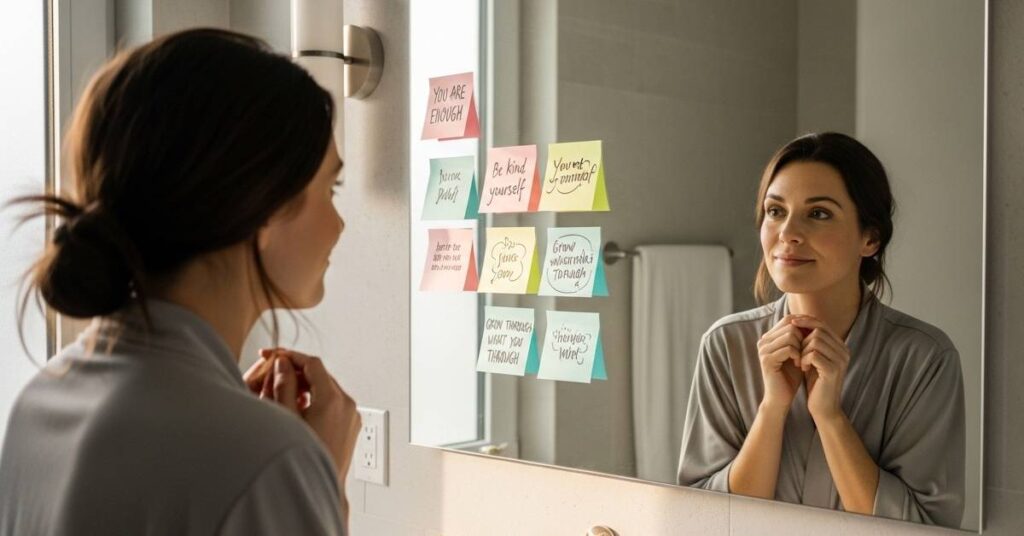
Model Sharina Gutierrez, a 2024 SI Swimsuit rookie, mentioned using Post-it notes on her mirror. This became my entry point. I started with just one.
I wrote: What I say carries weight.
I placed it on my bathroom mirror.
Every morning during my routine, I’d see it. During the first week, I’d smirk skeptically. However, by week two, I noticed myself speaking up just slightly more during discussions. By week three, I actually believed it. That tiny sticky note began rewiring my thought patterns. It greeted me each morning and bid me goodnight. Gradually, it sank into my consciousness.
The Commute Practice
I have a 20-minute drive to run errands. I’m not a meditation guru, but I can practice mindfulness in my car. I’d choose one mindset affirmation for the entire week. For instance, I’d repeat: I rely on my own wisdom.
Every red light became a cue to repeat it. Every traffic delay turned into a learning moment. I’d speak it aloud, practicing the tone I’d use if I genuinely trusted myself. By week’s end, I was making choices more quickly. Additionally, I was second-guessing myself far less.
The Bedtime Ritual

Evenings used to be when anxiety attacked. I’d lie awake replaying every awkward moment since elementary school. The darkness seemed to amplify every doubt.
Now, I’ve established a nighttime routine. I spritz lavender mist. I change into comfortable clothes. Then, as I settle in, I softly repeat calming affirmations. My regulars are:
-
I gave what I could today. Now I rest.
-
I release today with thanks and let it go.
-
My body and mind deserve peaceful rest.
This signals my nervous system that the day’s battles are over. It’s like gently tucking my own mind into bed.
The Hormonal Reality Check
Let’s be honest. Some days, negative thoughts are chemically driven. There’s incredible freedom in acknowledging: My hormones influence my feelings, but my feelings remain valid.
This realization transformed everything. For years, I’d dismiss my emotions during certain times of the month. Now I honor them instead. My body experiences natural cycles, and it’s normal to feel more sensitive. That doesn’t make my feelings less authentic. It simply means I need extra gentleness. I pair this with, I respect my body’s rhythms and honor its needs.
Best Positive Affirmations for Women
Over time, I’ve assembled a collection that serves as my emotional first-aid kit. I don’t recite them all daily. Instead, I reach for them based on whatever life throws my way.
When You Feel Overlooked
-
I deserve to be seen and heard.
-
My perspective adds value to any conversation.
-
I carry myself with quiet assurance.
When You Feel You’ve Stumbled
-
I have the resilience to get back up when life knocks me down.
-
Every setback carries a lesson I needed to learn.
-
I release past errors and embrace this present moment.
When You’re Completely Drained
-
Rest restores me; I don’t need to justify it.
-
Recharging is productive. I’m refilling my reserves.
-
Choosing myself is never selfish.
When You Need to Reconnect With Yourself
-
I am always changing into the person I am meant to be.
-
I am complete, right here, right now.
-
My gentleness is my greatest asset.
When Affirmations Aren’t Enough
A crucial disclaimer belongs here. Sometimes, words simply aren’t sufficient. If you’re experiencing profound depression, unresolved trauma, or debilitating anxiety, whispering “I am at peace” can feel hollow and even harmful.
During such times, affirmations can serve as a bridge toward seeking help. They can be the gentle nudge that says, “You deserve support. Please find someone qualified to help you.” Seeking professional help isn’t failure. On the contrary, it’s the deepest form of self-care.
Final Thoughts: A Letter of Kindness to Yourself
So, after years of doubt, what’s my genuine conclusion about all of this?
I believe it’s an act of quiet rebellion.
In a world that profits from our self-doubt, declaring “I am enough” becomes revolutionary. In a society urging us to stay small, stating “my voice deserves to be heard” is claiming power. In a culture worshiping busyness, murmuring “I deserve true rest” is defiance.
My Nana never used the word affirmations. She called it “talking some sense into yourself.” But that’s truly what this is. It’s us, as grown women, finally talking sense into ourselves. It’s the comforting hand on our own shoulder. Ultimately, it’s becoming our own most loyal friend.
Begin wherever you are. Use the cheesy phrases, the raw ones, the ones that make you emotional, or the ones that make you laugh. Stick them on your mirror. Whisper them during your drive. Shout them into your pillow if needed.
You’re constructed from stronger material than you realize. It’s time your inner world acknowledged that truth.
Frequently Asked Questions
Q1: Do positive affirmations really work?
They work, but not as instant magic. They function by gradually reshaping neural pathways through consistent practice. Consider them mental exercise. You won’t see results from one sit-up, but regular practice creates genuine change. The secret lies in pairing words with authentic feeling, even if that feeling starts as a tiny spark.
Q2: How often should women practice affirmations?
Regularity matters more than duration. Five minutes daily outperforms one hour weekly. Many women successfully integrate them into existing routines during morning prep, daily commutes, or evening wind-down. The objective is habit formation, not added burden.
Q3: Can affirmations reduce stress and anxiety?
Research indicates they can help calm the nervous system. Repeating soothing statements activates your brain’s reasoning center. Simultaneously, it reduces activity in your fear response area. For everyday stress and general anxiety, they’re genuinely helpful. However, they shouldn’t replace professional care for diagnosed conditions.
Q4: What are the best daily affirmations for women?
The most effective affirmations target your personal struggles. That said, universally helpful options include:
-
I am worthy, exactly as I am.
-
I believe that I can handle anything that comes my way.
-
My thoughts and feelings deserve expression.
-
Rest is essential, not optional.
-
I’m writing my own life story.
Q5: How do I stop feeling foolish saying affirmations?
Meet yourself where you are. If “I am confident” feels false, try gentler versions. For example, say “I’m learning to trust myself” or “I’m open to believing in my worth.” You can also combine words with physical actions like hand on heart or deep breathing. This helps bypass your skeptical mind and connect with your body.
Important Disclaimer: The content in this article is based on personal experience and research for informational purposes only. It is not intended as a substitute for professional medical advice, diagnosis, or treatment. Always seek the advice of your physician, therapist, or qualified mental health provider with any questions you may have regarding a medical or psychological condition. Never disregard professional advice because of something you read in this article.
1 thought on “Positive Affirmations for Women: A Real-Life Journey to Self-Worth”