

Do you ever feel like that critical voice in your head just won’t shut up? I’ve been there. Honestly, when I first heard about positive affirmations for self esteem, I rolled my eyes. It felt like something only life coaches and Instagram influencers did. But after hitting rock bottom with my own confidence a few years ago, I got desperate enough to try anything. What I discovered surprised me.
Learning to use positive affirmations for self esteem is one of the most effective ways to silence your inner critic. When practiced correctly, these simple statements can rewire your neural pathways. They help you break free from negative thought patterns and step into a more empowered version of yourself.

In this guide, I’ll share what actually worked for me and what the research says. You’ll get powerful phrases to use daily and a practical roadmap to overcome self-doubt for good.
What Are Positive Affirmations and Why Do They Matter?
Positive affirmations are short, powerful statements you repeat to yourself. They challenge and overcome self-sabotaging thoughts. They encourage you to visualize and believe in what you’re affirming.
When we specifically talk about positive affirmations for self esteem, we’re targeting the core belief system that determines how valuable and capable we feel.
Low self-esteem usually stems from negative internal monologue. It’s that stream of unconscious thoughts telling us we’re not good enough. Affirmations act as the antidote. They consciously inject positivity into that monologue.
The Neuroscience: Why This Actually Works
Many people dismiss affirmations as wishful thinking. I used to be one of them. But neuroscience tells a different story.
Our brains have neuroplasticity. They can change and adapt throughout our lives. This isn’t just motivational speaking. It’s biology.
Self-affirmation theory suggests we’re motivated to maintain a sense of self-integrity. When we affirm our values and worth, we broaden our perspective. We see the big picture and reduce the impact of negative feedback.

A study published in the journal Social Cognitive and Affective Neuroscience used fMRI scans. Researchers found that practicing self-affirmations activates the ventromedial prefrontal cortex. That’s the part of your brain associated with positive valuation and self-related information processing.
Dr. Caroline Leaf, a communication pathologist and cognitive neuroscientist, explains it simply: “Every time you have a thought, your brain changes physically.” So when you consistently repeat positive affirmations for self confidence and success, you’re literally building new bridges in your brain.
The Real Benefits I Experienced
When I started using daily affirmations for confidence, I noticed changes I wasn’t expecting.
Stress dropped. I used to panic before meetings. After a few weeks of affirmations, my heart didn’t race the same way.
Resilience increased. Setbacks that would have ruined my week started rolling off my back faster. I bounced back quicker.
Health habits improved. This surprised me most. When I felt better about myself, I naturally wanted to take better care of my body. I slept better. I moved more.
Performance got better at work. Studies back this up. People who use affirmations before high-pressure tasks perform better than those who don’t. Affirmations disrupt the cycle of anxiety that leads to poor performance.
45 Powerful Positive Affirmations for Self Esteem and Confidence
To truly change your mindset, you need phrases that resonate with you. Below, I’ve categorized affirmations that worked for me and my clients. Choose the ones that give you a feeling of relief or a tiny spark of hope.
Foundational Self Love Affirmations for Confidence and Self Esteem
These are the building blocks. They focus on your inherent value, regardless of external achievements.
-
I am enough, exactly as I am
-
I love and accept myself unconditionally
-
My worth isn’t determined by my productivity
-
I deserve respect and kindness
-
I choose to be my own biggest fan
-
I am worthy of love, even on my bad days
-
My feelings matter
Affirmations for Confidence in Social Situations
If social anxiety is your struggle, these affirmations for confidence can help you feel more at ease around others.
-
I bring unique value to every conversation
-
My voice matters and people want to hear what I say
-
I am calm and confident around others
-
I attract positive, supportive people
-
I am comfortable being myself
-
I deserve to take up space
-
People enjoy my presence
Affirmations to Overcome Imposter Syndrome
Many high achievers feel like frauds waiting to be discovered. These positive affirmations to overcome self doubt are essential for neutralizing those feelings.
-
I deserve my success. I worked hard to get here
-
I have the skills to handle any challenge
-
I accept praise graciously because it’s deserved
-
I’m learning and growing every day, and that’s enough
-
My unique perspective is an asset, not a flaw
-
I belong at this table
-
I didn’t get lucky. I earned this
Affirmations for Professional Success
Boost your career by reinforcing your professional competence with these best affirmations for self confidence daily.
-
I am a talented and capable professional
-
I handle challenges with grace and intelligence
-
Success flows naturally to me
-
I trust my ability to make decisions
-
My work makes a positive impact
-
I am confident in meetings
-
My ideas have value
Affirmations for Body Image and Self Love
Your relationship with your body is a huge part of overall self-esteem. Use these self love affirmations for mental health to foster a kinder relationship with your physical self.
-
I’m grateful for my body and all it does for me
-
I am beautiful because I’m unique
-
I treat my body with love and respect
-
I am more than my reflection
-
My body is my home, and I choose to love it
-
I don’t need to change my body to be worthy
-
My value isn’t measured by a scale
How to Build Self Confidence Using Affirmations: What Actually Worked for Me
Simply reading a list of words won’t change your life. Trust me. I learned this the hard way. To understand how to build self confidence using affirmations, you must move from passive reading to active rewiring.

Here’s the method that finally worked for me after years of skepticism.
Step 1: Get Honest About Your Inner Critic
Before you can apply the antidote, you need to know what poison you’re dealing with.
Grab a notebook. Write down the repetitive negative thoughts you have about yourself.
For me, it was:
-
“I’m not smart enough to succeed”
-
“People think I’m awkward”
-
“I always mess things up”
Once you have these, craft your positive affirmations for self esteem to directly counteract them.
My negative thought: “I’m not smart enough”
My counter affirmation: “I am intelligent and capable of learning anything I set my mind to”
Be specific. The more directly your affirmation targets your specific doubt, the better it works.
Step 2: Try the Mirror Work (Even Though It Feels Awkward)
This is the most uncomfortable but effective technique. I almost quit on this step. I’m glad I didn’t.
Stand in front of a mirror. Look into your own eyes. Say your chosen affirmation out loud.
The first time I said “I love and accept myself” while looking at my own face, I cried. Not because I was happy. Because it felt so foreign. So untrue.
I kept going anyway. That vulnerability is where the healing happens.
Step 3: Feel the Words, Don’t Just Say Them
Rote repetition is boring for your brain. To truly engage neuroplasticity, you must feel the words.
When I say “I am confident,” I visualize a time I felt confident. Maybe it was a conversation with a friend where I felt heard. Maybe it was finishing a project I was proud of.
I recall that feeling in my body. The warmth. The calm.
If you say “I am successful,” imagine what success looks like for you. What does it feel like? What does it smell like?
By pairing words with sensory experience, you signal to your brain that this matters. You’ll start noticing opportunities for success and confidence in your daily life.
Step 4: Consistency Beats Intensity Every Time
You don’t need to spend an hour a day on this. I certainly didn’t have that kind of time or patience.
I spent 2-3 minutes every single day. That’s it.
The key to daily affirmations for confidence and success is the “daily” part, not the “hourly” part.
Morning routine: I said my affirmations while making coffee
Evening routine: I repeated them while brushing my teeth
Tie it to habits you already have. You’ll actually stick with it.
What I Learned About the “I Don’t Believe It” Problem
The most common objection to positive affirmations for self esteem is: “But I don’t believe what I’m saying. It feels like a lie.”
I felt this deeply. When my self-esteem was at its lowest, declaring “I am the most confident person in the world” would have made my inner critic laugh at me. It would have backfired completely.
Here’s what actually works.
Use Bridge Affirmations
Instead of jumping from “I hate myself” to “I love myself,” meet yourself where you are. Bridge affirmations are believable stepping stones.
Instead of: “I am perfect”
Try: “I am open to the idea that I have value”
Instead of: “I am fearless”
Try: “I am brave enough to face my fears today”
Instead of: “I am wildly successful”
Try: “I am taking small, consistent steps toward my goals”
Instead of: “Everyone loves me”
Try: “I am worthy of connection with the right people”
This method lowers psychological resistance. Your brain accepts “I am open to the possibility” much easier than a statement that contradicts your current reality.
Start where you are. Not where you wish you were.
Real Story: How Affirmations Changed My Public Speaking Nightmare
Let me share a personal story that made me a believer.
A few years ago, I had to present at a small team meeting. Nothing major. Maybe 15 people. But my belief was crystal clear: “I am a terrible speaker.”
This belief made me nervous. Being nervous made me rush through my words. Rushing made me stumble. Stumbling confirmed my belief. I was trapped in a cycle.
I started using positive affirmations for self confidence and success specifically targeting this fear. Every morning for three weeks, I looked in the mirror and said:
-
“I have valuable ideas to share with my team”
-
“I speak clearly and calmly”
-
“People benefit from hearing what I have to say”
Did I believe it at first? Absolutely not. Felt completely fake.
But around week three, before a different team meeting, I noticed something. My heart wasn’t racing. I wasn’t rehearsing frantically in my head.
When I spoke, I was slower. More present. I actually made eye contact with people.
I wasn’t reciting an affirmation in my head. I had become the affirmation.
By changing my internal dialogue, I changed my external behavior. This is the practical reality of how to overcome self doubt with affirmations. It’s not magic. It’s practice.
Integrating Affirmations Into Your Real Life
To ensure you actually stick with this, integrate the practice into habits you already have.
While brushing your teeth: Use those two minutes. Repeat your core affirmation. Nobody’s watching. Just do it.
During your commute: Turn off the news. Instead, repeat your daily positive affirmations for self confidence silently. Or play a guided affirmation track. I used this time to reprogram my brain without adding extra minutes to my day.
Sticky notes: This sounds cheesy. I thought so too. But placing sticky notes with phrases like “I am enough” on my bathroom mirror actually helped. You can’t avoid your own reflection. You can’t avoid the words.
Phone reminders: Set 2-3 random alarms on your phone. Label them with one word. “Breathe.” “Confidence.” “Enough.” When the alarm goes off, take five seconds. Repeat your affirmation. That’s it.
Before meals: Take one deep breath before eating. Say your affirmation silently. It adds maybe three seconds to your meal.
What the Research Actually Says
I mentioned the fMRI study earlier. Let me give you more specifics.
Researchers at the University of California, Los Angeles (UCLA) used functional magnetic resonance imaging to watch what happens in the brain during self-affirmation. Dr. Matthew D. Lieberman, a neuroscientist at UCLA, led research showing that affirmations activate the brain’s reward centers.
Another study from Carnegie Mellon University found that self-affirmation helps maintain wellbeing during stressful situations. Participants who practiced affirmations had lower cortisol levels and problem-solved better under pressure.
Dr. Kristin Neff, a pioneer in self-compassion research at the University of Texas at Austin, has shown that treating yourself with kindness activates the same neural pathways as affirmations. It’s not separate work. It’s connected.
This isn’t fluff. It’s documented neuroscience.
Common Mistakes I Made (So You Don’t Have To)
I messed up plenty when I started. Here’s what didn’t work.
Using affirmations that were too long. Short phrases stick better. Your brain grabs onto “I am enough” easier than a paragraph.
Saying them once and expecting change. One time doesn’t rewire anything. Daily repetition is the requirement.
Picking affirmations I hated. If the words don’t resonate, they won’t work. Find phrases that feel even slightly true. Or use bridge affirmations.
Quitting when it felt fake. The fakeness is part of the process. It means you’re stretching beyond your current belief system. That’s exactly where growth happens.
Not tracking progress. I wish I had journaled. Even a few sentences each week would have shown me how far I’d come.
Your Simple 5-Minute Daily Plan
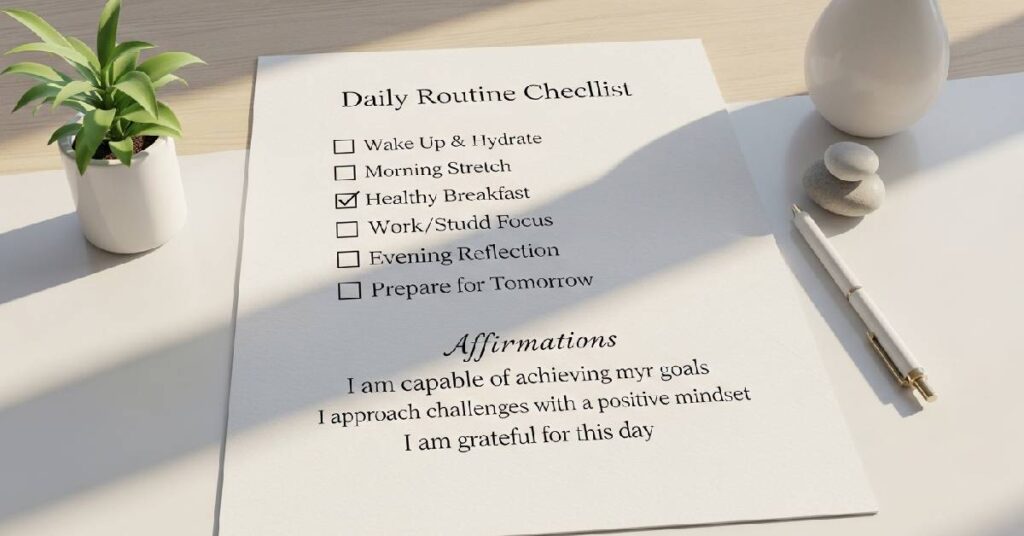
Here’s exactly what I recommend to clients who want to start today.
Morning (2 minutes):
-
Stand in front of a mirror or sit quietly
-
Take three deep breaths
-
Repeat your chosen affirmation 5 times out loud
-
Say it slowly. Mean it as much as you can.
Midday (30 seconds):
-
Set a random alarm
-
When it goes off, pause
-
Repeat your affirmation silently once
Evening (2 minutes):
-
Before bed, close your eyes
-
Reflect on one moment today where you felt slightly better than yesterday
-
Repeat your affirmation 3 times
-
Thank yourself for showing up
That’s it. Five minutes total. Anyone can do this.
Conclusion
Building genuine self-esteem isn’t an overnight event. It’s a daily practice. I learned this the hard way through skepticism, awkward mirror sessions, and gradual change.
By consistently using positive affirmations for self esteem, you’re not just reciting pretty words. You’re actively engaging neuroplasticity to reshape your brain. You’re choosing to water the seeds of confidence, self-love, and resilience within you.
Start small. Pick just one affirmation from the list above that resonates with you. Say it to yourself right now. Say it again tomorrow. Say it again the next day.
Over time, those words will transform from a whisper of hope into the loudest truth you know about yourself. That you are, and always have been, enough.
Frequently Asked Questions
1. How long does it actually take for positive affirmations to work?
Based on my experience and the research on neuroplasticity, noticeable shifts usually happen between 3 to 6 weeks of consistent daily practice. But you might feel small changes earlier. I felt a tiny difference after about 10 days. The key isn’t the length of time. It’s the emotional intensity and repetition you bring to the practice.
2. What’s the difference between affirmations for self esteem and affirmations for confidence?
They overlap but aren’t the same. Self-esteem affirmations focus on your inherent worth. Things like “I am worthy of love no matter what.” Confidence affirmations focus on your trust in your abilities. Like “I trust myself to handle difficult situations.” You need both to feel truly secure. Self-esteem is the foundation. Confidence is what you build on top of it.
3. Can I use multiple affirmations at once or should I focus on one?
For beginners, stick with 1 to 3 core affirmations that target your biggest struggle. When I started, I used one. Just one. After a few weeks when it started feeling natural, I added another. Depth matters more than breadth in the beginning. You want to rewire one pathway deeply before building new ones.
4. Are positive affirmations actually backed by psychology or is this self-help fluff?
Yes, they’re backed by legitimate research. They’re rooted in self-affirmation theory developed by Claude Steele at Stanford. They’re also a key component of Cognitive Behavioral Therapy, which is one of the most researched and effective therapeutic approaches. The fMRI studies from UCLA and others show real brain changes. This isn’t just motivational speaking. It’s neuroscience.
5. Do I have to say affirmations out loud or can I just think them?
Saying them out loud is the most powerful method. It involves auditory and motor sensory input, which strengthens the neural pathway more than thinking alone. That said, thinking them or writing them down still works. Out loud is the gold standard. But any practice is better than none. On days when I couldn’t bring myself to speak, I’d whisper. Or write. Or just think it. It all counts.
Disclaimer: The information in this article is for educational and informational purposes only and is not intended as medical or professional psychological advice. While positive affirmations can support mental wellness, they are not a substitute for professional help. If you’re struggling with severe anxiety, depression, or other mental health concerns, please consult a qualified mental health professional.
1 thought on “Positive Affirmations for Self Esteem: Science-Backed Daily Guide”